

Robarts Home to Canada's First MPI System
November 24, 2019Magnetic Particle Imaging (MPI) – considered the most promising and emerging imaging technology of the  past 20 years – has arrived at Robarts Research Institute in London, Ontario, Canada. The MPI system will serve as the technological talisman for molecular and cellular imaging scientists at Robarts and bacteriologists, virologists and immunologists in Schulich Medicine & Dentistry’s Department of Microbiology & Immunology.
MPI is an innovative, ultrasensitive imaging modality that directly detects iron oxide nanoparticle tracers using magnetic fields. Researchers will use the system to track cells in models of disease and therapy, including immune cells used to treat cancer and stem cells for the treatment of neurological and vascular conditions.
“This research will allow for better understanding of disease progression, identification of successful treatments, and early and accurate detection of disease,” explained Paula Foster, PhD, Scientist at Robarts and Professor with the Department of Medical Biophysics.
This is Canada’s first MPI system and only the sixth in the world. “As a brand new imaging technology, there are unique opportunities to further develop the technique and push the limits of sensitivity for tracking cells, pathogens and molecules,” said Foster. “Nearly all experiments performed on this system will be first-ever.”
Funding for the equipment was provided through a Canada Foundation for Innovation Grant which supports Canada’s universities, colleges, research hospitals and non-profit research organizations to increase their capability to carry out high quality research.
A Voice for Magnetism in Europe
November 24, 2019The purpose of the European Magnetism Association (EMA) is to promote the development of magnetism and magnetic materials in Europe, through rising the visibility and the impact of research on fundamental and applied magnetism. EMA acts as an umbrella organization for activities in magnetism in Europe, giving magnetism a voice in the concert of physical sciences.
 EMA addresses:
- Education and training in the field of magnetism
- Advancement in the understanding of magnetism
- Developments in magnetism and related applications
- Links with companies active in magnetic materials and devices
- Representation of the magnetism community worldwide
- Dissemination of the results of magnetism research in Europe
- Contribution to networking through a job market, agenda and newsletter
If you would like to receive EMA's newsletter, http://magnetism.eu/86-mailing.htm, or become a free member, then please visit their website: magnetism.eu.
Did You Know ...
November 22, 2019 … that H.C. Ørsted was awarded the pharmaceutical master's degree in 1797, and that he was strongly involved in the development of the pharmaceutical degree programme? His lectures were the first at the University of Copenhagen that women were allowed to attend. This is the reason why an Ørsted bust on a travertine pedestal adorns the main entrance to the PharmaSchool, Universitesparken 2. Remember, this is also not far where we had our 12th Magnetic Carrier meeting!
Next year is the 200th anniversary of Ørsted's discovery of electromagnetism. On 21 April 1820, during a lecture, Ørsted noticed a compass needle deflected from magnetic north when an electric current from a battery was switched on and off, confirming a direct relationship between electricity and magnetism.
His initial interpretation was that magnetic effects radiate from all sides of a wire carrying an electric current, as do light and heat. Three months later he began more intensive investigations and soon thereafter published his findings, showing that an electric current produces a circular magnetic field as it flows through a wire. For his discovery, the Royal Society of London awarded Ørsted the Copley Medal in 1820 and the French Academy granted him 3,000 francs.
Ørsted's findings stirred much research into electrodynamics throughout the scientific community, influencing French physicist André-Marie Ampère's developments of a single mathematical formula to represent the magnetic forces between current-carrying conductors. Ørsted's work also represented a major step toward a unified concept of energy.
Best Practices for Characterization of Magnetic Nanoparticles for Biomedical Applications
October 28, 2019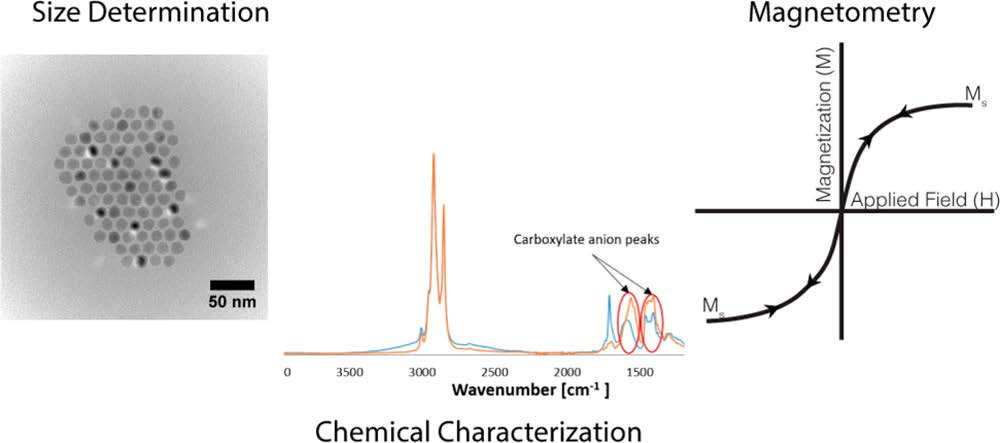 The use of magnetic nanoparticles in biomedical applications provides a wealth of opportunities. Nonetheless, to truly understand the interactions of these materials in biological media, detailed characterization is necessary with these complex systems. Prof. Thompson Mefford together with Sarah E. Sandler and Benjamin Fellows just published an article that might be very helpful to many of our colleagues.
The article highlights some “best practices” in the analytical techniques and challenges in the measurement of the properties of these materials.
Check it out here, it is worth reading!
Complete JMMM Special Issue After the 2018 Meeting Is Now Available
October 07, 2019 It is our great pleasure to announce the official publication of the special JMMM issue after our 2018 meeting in Copenhagen.
At the end, we have now 75 interesting publications in our special issue. We hope you will all take the time to download, browse through the articles, and enjoy the new and interesting magnetic particle themes that all of your colleagues wrote about.
We make it easy for you - go to this website, and check them all out!
And then start planning for the next meeting in London, UK. Next June 2-5, 2020!
Watch Liquid-Based Magnet Droplets Twirl and Morph
July 23, 2019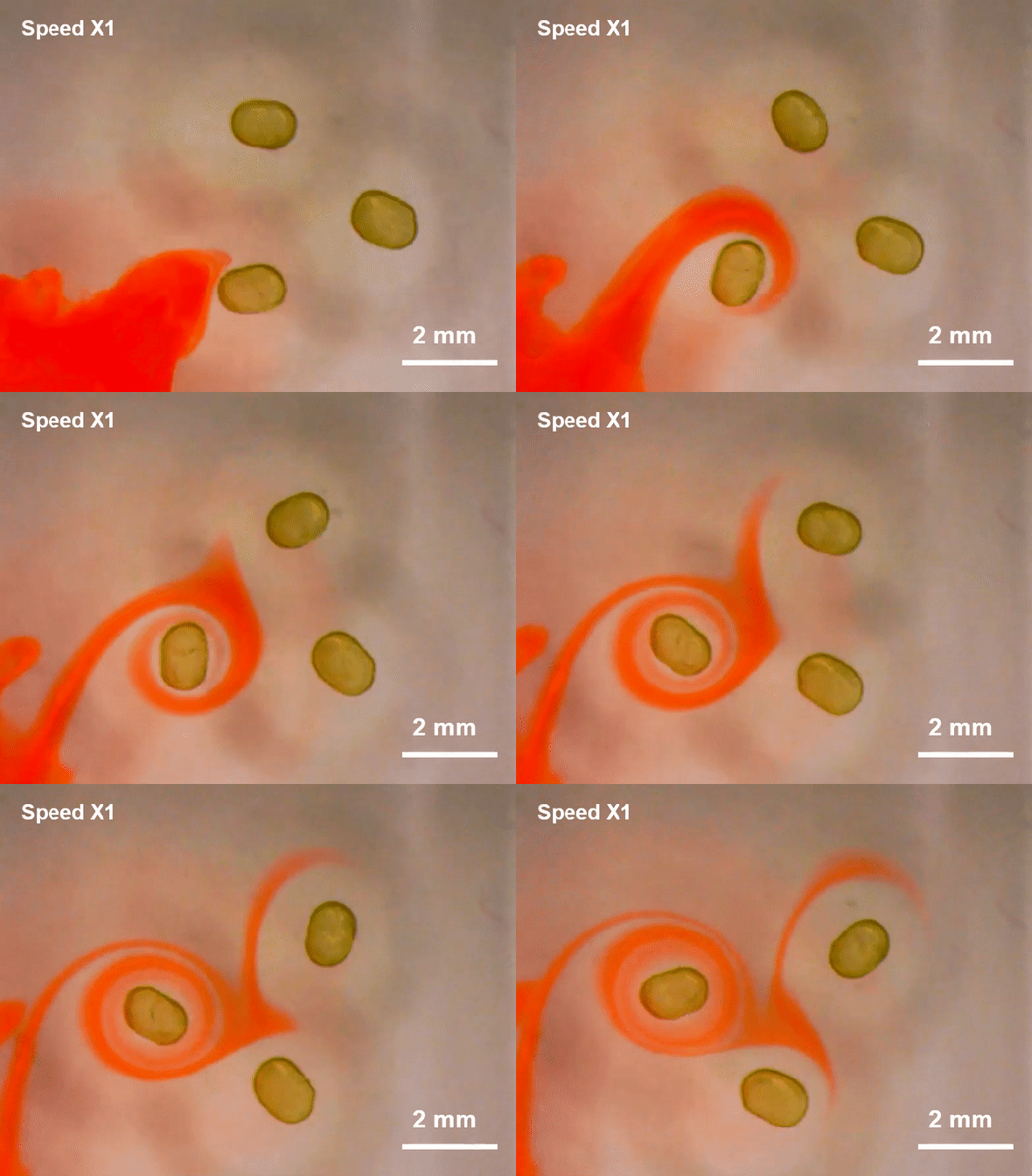 Researchers at Lawrence Berkeley National Laboratory (LBNL) have created a more malleable tool: a miniscule liquid-based magnet made from nanoparticles.
Such flexible magnets could be useful in places where rigid ones cannot go, including soft robots or flexible electronics. And although they are not yet ready for practical applications, the liquid-based magnets reveal a new facet of nanoparticle behavior, which could pave the way for a novel range of magnetic materials, the researchers say.
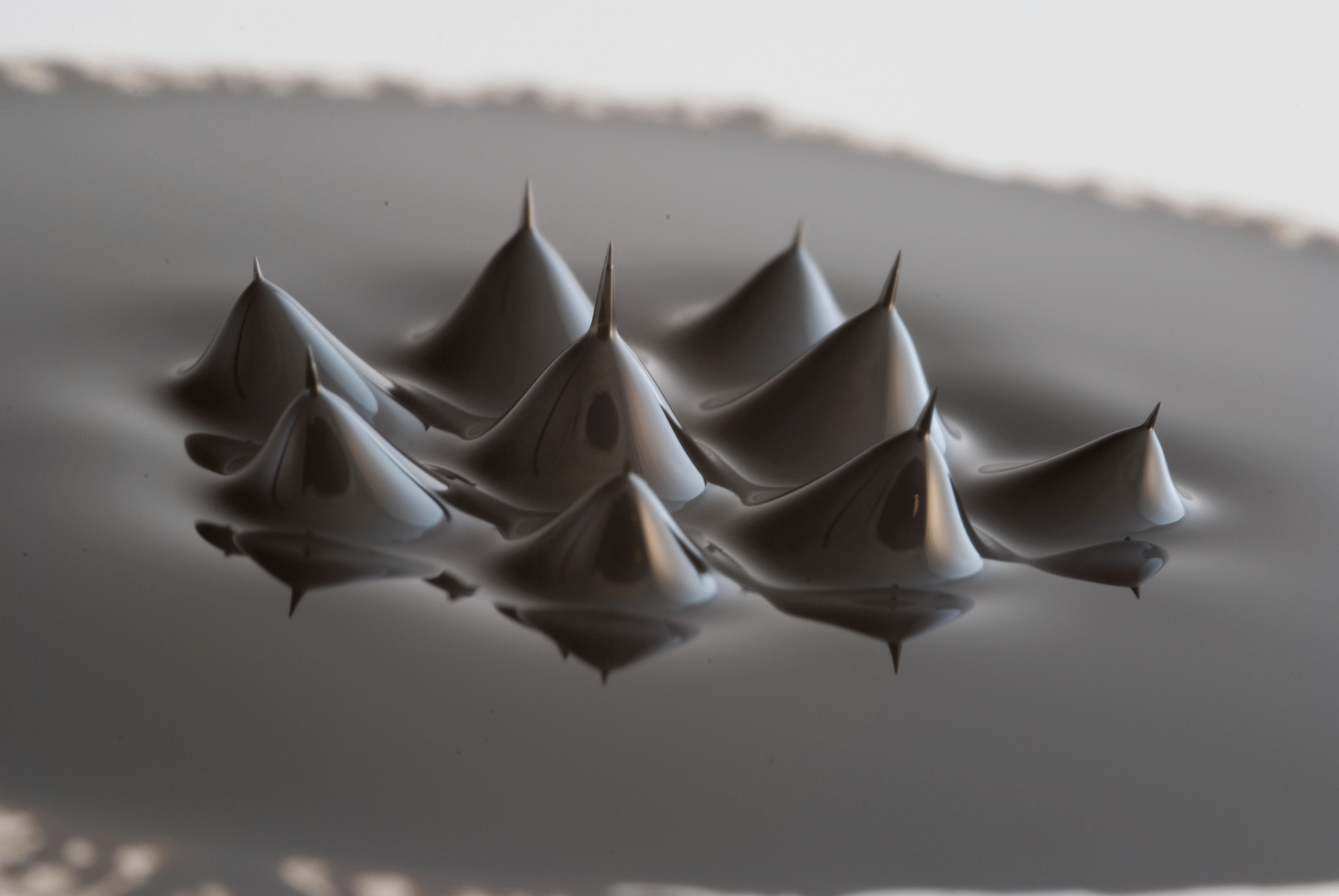
To create the liquid-based magnets, researchers led by Thomas P. Russell, a polymer scientist at the University of Massachusetts Amherst and a visiting researcher at LBNL, started with a modified 3-D printer. First, they printed millimeter-sized droplets of liquid filled with magnetic nanoparticles. This liquid-particle mix is superparamagnetic—it is strongly attracted to a magnetic field, but as soon as the field disappears, so does the magnetism. In plain language, it is magnetic but not a magnet—a characteristic typical of fluids that can be magnetized, called ferrofluids.
Bubble Magnetometry Highlights Nanoparticle Heterogeneity and Interaction
June 10, 2019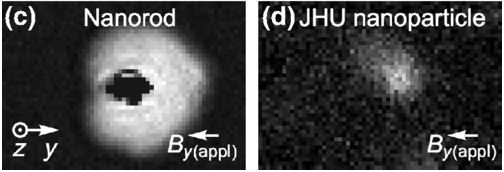 Several authors from NIST (Andrew Balk, Ian Gilbert, John Unguris, Samuel Stavis) and also Robert Ivkov from Johns Hopkins published recently in Physical Review Applied an interesting article that highlights heterogeneity of hysteresis behavior in nanorods and nanoparticles using magneto-optical Kerr effect (MOKE) microscopy. It is relevant when considering mechanisms of hysteresis heating and other time-dependent properties of magnetic nanoscale structures exposed to magnetic fields.
Check it out here.
Magnetic Nanoparticles Can Fix Broken Electric Wires
June 03, 2019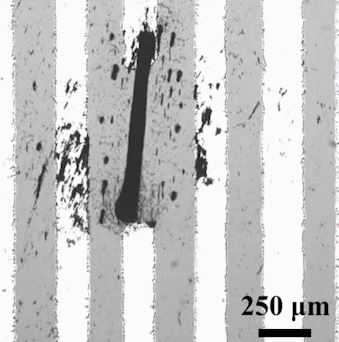 Inspired by armies of ants that link together to form living structures such as bridges and rafts, researchers have directed millions of nanoparticles to span the gap between two electrodes, forming an electrical wire (ACS Nano 2019, DOI: 10.1021/acsnano.9b02139). The technology could provide a new way to repair broken microcircuits and make tiny programmable microswitches, the researchers say.
Roboticists dream of emulating the natural swarming behavior of insects and birds to make robots that work together on construction tasks or search-and-rescue missions. Scientists have also been engineering swarming particles that could have applications on the microscopic scale, such as tracking down tumors and delivering drugs.
Li Zhang, a mechanical and automation engineer at the Chinese University of Hong Kong, and his colleagues are designing microswarms for electronic applications. In 2018, they reported using oscillating magnetic fields to control millions of magnetic iron oxide nanoparticles in an ethanol suspension (Nat. Commun. 2018, DOI: 10.1038/s41467-018-05749-6). Changing the field’s strength relative to the fluid’s resistance made the particles line up into ribbon-like chains. By programming other parameters of the magnetic field, such as the oscillation frequency and angle, the researchers could elongate and shorten the ribbons, and make the nanoparticles split up and regroup. They could also make the swarms move through a maze.
For more information, check out our Archives.
September 2017
Search this site with the power of